The Jantar Mantar confrontation has brought youth-led activism, opposition politics, the Election Commission and judicial scrutiny into the same political conversation. Whether this becomes a national movement will depend on evidence, public participation and the institutions now under pressure.
By: Javid Amin | 15 October 2026
New Delhi — India’s latest political confrontation is no longer confined to the detention of Cockroach Janta Party (CJP) leaders at Jantar Mantar or Rahul Gandhi’s criticism of the action. It has become part of a wider debate over the right to protest, the credibility of electoral institutions, the space available to young political activists and the ability of the opposition to build a common national narrative.
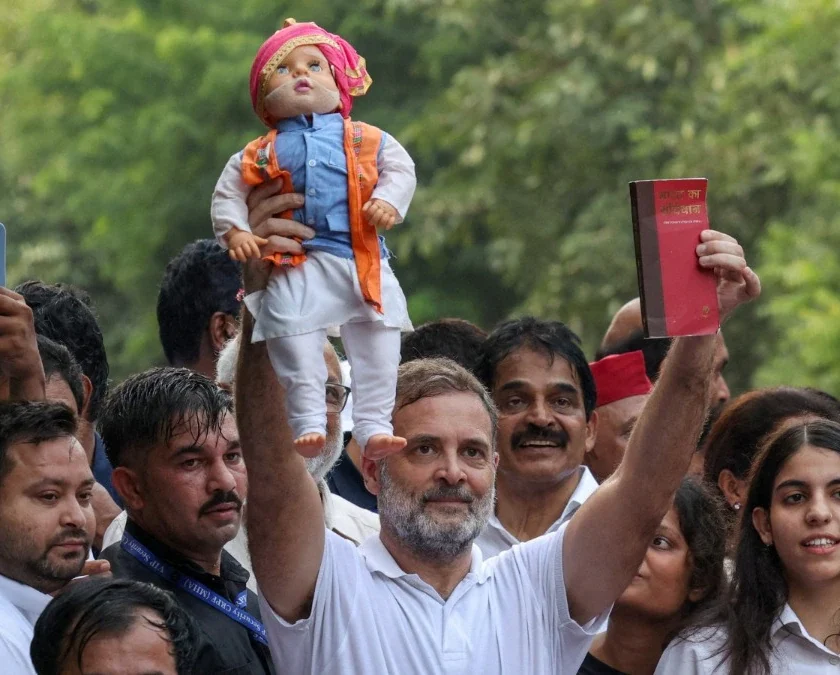
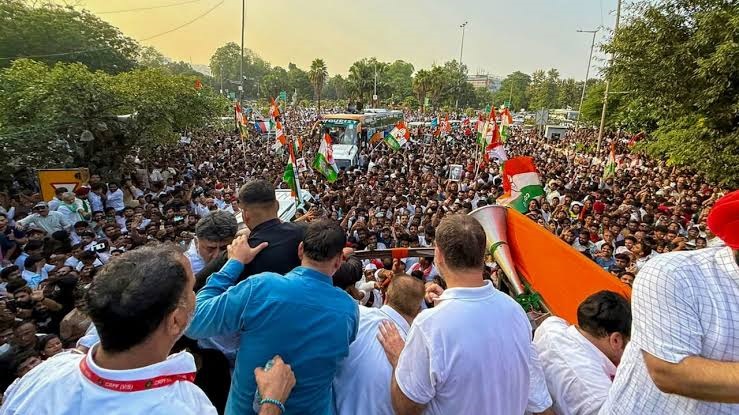
The immediate flashpoint is clear. CJP leaders Saurav Das and Ashutosh Ranka were sent to five days of judicial custody after allegedly entering Jantar Mantar, which authorities had recently removed from the list of designated protest venues. Delhi Police have cited alleged trespass, obstruction of public servants and violations of earlier peace bonds. CJP, meanwhile, has presented the action as an attack on peaceful dissent. Rahul Gandhi publicly backed the leaders, arguing that waving the Tricolour at Jantar Mantar was not a crime.
But the political significance of the episode extends beyond the competing accounts of one protest. At almost the same time, Rahul Gandhi and other INDIA bloc leaders approached the Supreme Court over alleged irregularities in the Election Commission’s Special Intensive Revision (SIR) of electoral rolls. The petition has yet to reach a substantive hearing because the Supreme Court Registry identified procedural defects that must be addressed.
These developments are legally distinct, but politically connected by a common question: how much public confidence do India’s democratic institutions command, and how should disputes over that confidence be resolved?
The answer could influence the political climate leading towards the 2029 Lok Sabha election. It is too early, however, to conclude that the current agitation will develop into a nationwide movement or significantly alter the electoral balance.
Five players, one expanding political contest
The confrontation brings five major actors into focus: Prime Minister Narendra Modi and the Bharatiya Janata Party (BJP), Rahul Gandhi and the INDIA opposition bloc, the emerging CJP movement, the Election Commission of India and the Supreme Court.
Each occupies a different position in the dispute.
The BJP and the government are associated with the defence of administrative authority, public order and the existing institutional framework. Congress and its opposition partners are seeking greater scrutiny of electoral processes and stronger protections against alleged voter exclusion. CJP is attempting to establish itself as a youth-led voice challenging established political and institutional power.
The Election Commission is at the centre of questions about the accuracy, transparency and administration of electoral rolls. The Supreme Court, meanwhile, could become an important forum for resolving legal challenges, provided the cases meet the requirements for judicial consideration.
These positions should not be mistaken for a single coordinated confrontation. The parties have different objectives, and the allegations raised by political actors have not automatically been established as facts.
Nevertheless, the overlap has created a politically consequential moment. A dispute that began with a protest has become connected to questions about electoral administration, institutional accountability and the limits of dissent.
Why CJP matters beyond its organisational size
The importance of the Cockroach Janta Party cannot be measured solely by its electoral strength or formal political infrastructure.
Its emerging relevance lies in the issues around which it has mobilised: examination-related controversies, paper-leak concerns, demands for accountability and allegations of irregularities in electoral rolls. These themes touch on wider anxieties among young people about opportunity, fairness and the responsiveness of public institutions.
For many students and young jobseekers, questions of governance are experienced through practical concerns. They include the reliability of recruitment examinations, delays in filling vacancies, uncertainty over career prospects and whether established systems treat citizens fairly.
When these grievances become connected to a broader political argument, a small organisation can sometimes attract attention well beyond its immediate membership.
Digital platforms can accelerate that process. They allow activists to circulate videos, organise supporters and attract national attention without first building the extensive local structures traditionally required by political parties. But online visibility does not necessarily translate into sustained public participation, broad-based support or electoral influence.
That distinction will be crucial for CJP.
The organisation’s challenge is to turn attention into a durable movement with clear demands, credible evidence, transparent leadership and a capacity to engage with people outside its existing supporter base.
Its current significance is therefore primarily symbolic and political. It has become a focal point for debates about youth activism and institutional accountability, but its long-term influence remains uncertain.
Rahul Gandhi’s intervention: an opening for broader opposition politics?
Congress had initially maintained a degree of distance from CJP’s agitation. Rahul Gandhi’s subsequent public support for its leaders following their detention has brought the protest into a larger opposition narrative.
His statement that waving the Tricolour at Jantar Mantar is not a crime, alongside his criticism of the leaders’ custody, shifts attention from the immediate police case towards a broader argument about democratic freedoms and the right to protest.
The intervention also presents Congress with a political opportunity: to connect youth-led activism with its own campaign on electoral transparency and institutional accountability.
The strategic logic is understandable. A movement centred on election-related concerns could offer opposition parties a common issue around which they might mobilise supporters with different regional and ideological priorities.
However, it would be premature to describe Rahul Gandhi’s support as proof that Congress has adopted CJP as a formal political partner or that a unified movement has already emerged. Public backing for a protest does not, by itself, establish an organisational alliance.
Congress must also navigate a delicate balance. If it appears to absorb a youth-led campaign into conventional party politics, it could weaken the independent identity that initially attracted attention to the movement. If it remains at a distance, it may struggle to convert public sympathy into a sustained political campaign.
For Rahul Gandhi and the INDIA bloc, the larger test is whether they can build a credible, evidence-based platform around electoral transparency and democratic accountability without allowing separate legal disputes to become indistinguishable from one another.
The BJP’s position: law, order and institutional authority
The government’s response to the wider controversy must be understood separately from the specific legal case against CJP members.
In the Jantar Mantar matter, police have argued that the protest site had been de-notified, that entry occurred without authorisation and that the action involved alleged breaches of earlier peace bonds and obstruction of public servants. These are the grounds cited by authorities, not findings that the accused have been convicted of the alleged offences.
The distinction matters. The right to protest does not automatically remove restrictions imposed under law, but the existence of a restriction does not end legitimate questions about its legal basis, scope, proportionality or implementation.
The central public-interest question is whether restrictions on demonstrations are applied according to clear and consistent rules, and whether citizens retain meaningful opportunities to express dissent through lawful channels.
Politically, the BJP has an interest in presenting governance as a matter of stability, legality and effective administration. Opposition parties, conversely, are challenging whether those principles are being balanced appropriately against civil liberties and institutional accountability.
It is not possible to establish from the current developments alone that the government is acting specifically to prevent the emergence of a national youth movement. Such a claim would require evidence beyond political interpretation.
What can be said is that the handling of the protest has created an additional point of confrontation between the authorities and their critics. How the case proceeds, and whether alternative protest arrangements provide meaningful access to public political space, will shape how the episode is perceived.
Delhi Police and the question of protest space
Jantar Mantar has long served as one of India’s most recognisable locations for demonstrations, placing protest movements within visible reach of the national political establishment and the media.
The decision to remove it from the list of designated protest venues has therefore acquired significance beyond the administrative question of where demonstrations may take place.
Authorities can regulate public spaces to manage traffic, security and public order. The controversy arises when restrictions affect a location closely associated with political expression, particularly when activists argue that the alternative venues do not provide an equivalent opportunity to make their demands visible.
Delhi Police say the CJP members entered the area without authorisation and violated applicable restrictions. CJP and its supporters argue that the action amounts to suppression of dissent. Both positions must be examined through the facts, applicable rules and legal proceedings rather than accepted solely on the strength of political claims.
The case also illustrates a recurring challenge in democratic governance: law enforcement agencies often become the immediate face of decisions that have wider political implications.
Police are responsible for enforcing applicable laws and maintaining public order. Questions about the policy governing protest venues, the proportionality of enforcement and the availability of lawful alternatives may involve broader administrative and legal considerations.
The issue, therefore, is not simply whether protesters should be allowed to occupy any public space at any time. It is whether the rules governing public demonstrations are transparent, proportionate and consistently applied, while preserving a meaningful space for peaceful political expression.
The Election Commission: electoral administration becomes a public-trust issue
The controversy over electoral rolls may have longer-term implications than the immediate confrontation at Jantar Mantar.
An election management body depends not only on its legal authority but also on public confidence that the electoral process is administered fairly. Political disagreement with the Election Commission is not, in itself, proof of wrongdoing. Equally, allegations of irregularities deserve a response grounded in verifiable records and transparent procedures.
The INDIA bloc’s petition concerning the SIR process alleges problems with voter deletions and the exercise of the Commission’s powers. The opposition has sought judicial scrutiny of relevant decisions and records, as well as greater safeguards around the revision process.
The Election Commission’s position and the evidence available through official records are central to assessing those allegations. Claims of systematic manipulation should not be treated as established merely because political parties have made them.
At the same time, the process of electoral-roll revision carries significant consequences for individual citizens. An eligible voter who is wrongly omitted can face practical obstacles to exercising a fundamental democratic role. Clear procedures for notice, verification, correction and appeal are therefore essential to maintaining confidence in the system.
The debate has become politically charged because it touches on the most basic requirement of electoral democracy: citizens must have confidence that eligible voters can participate and that disputes about the rolls can be resolved fairly.
For the opposition, the challenge is to substantiate its allegations with verifiable evidence. For the Election Commission, the institutional challenge is to ensure that its decisions and procedures are sufficiently transparent to withstand scrutiny.
The credibility of the process will ultimately depend on records, safeguards, explanations and lawful remedies—not political slogans alone.
The Supreme Court: an important forum, but not yet a verdict on the allegations
The INDIA bloc’s move towards the Supreme Court has shifted part of the dispute from political mobilisation to formal legal proceedings.
Rahul Gandhi and other opposition leaders filed a petition concerning alleged irregularities in the SIR process and sought scrutiny of Election Commission decisions. However, the petition was not listed for a substantive hearing after the Supreme Court Registry identified 14 procedural defects, including problems involving documents and other filing requirements.
This development must be interpreted carefully.
A Registry objection is a procedural matter. It is not a judicial ruling on whether the opposition’s allegations are correct, nor does it establish that the petition will ultimately succeed or fail. The defects must be addressed before the matter can progress through the relevant process.
The distinction is important because political narratives can easily blur the difference between a petition being filed, a court accepting it for consideration, a substantive hearing and a final judgment.
The Supreme Court may eventually be asked to examine the legal questions raised by the petition. Until then, it would be inaccurate to describe the court as having endorsed either side’s claims.
The legal route could become an important part of the wider confrontation. A substantive hearing, interim directions or a judgment could influence the debate over electoral-roll revision. But the outcome cannot be predicted solely from the filing of the petition or the Registry’s objections.
The courts are not substitutes for political debate, and political pressure cannot substitute for legal evidence. Their role is to assess matters within their jurisdiction according to law and procedure.
The deeper political mood: opportunity, frustration and institutional trust
The current developments intersect with three broader political currents.
First, youth frustration is a potentially powerful but diverse force. Concerns about recruitment examinations, paper leaks, unemployment and access to opportunities can generate anger across party lines. Yet young people are not a single political constituency. Their priorities, experiences and preferred forms of activism vary considerably.
A movement hoping to mobilise them nationally must demonstrate that it can address practical concerns as well as broader institutional questions.
Second, the opposition is searching for issues that can unite different political constituencies. The INDIA bloc brings together parties with distinct regional bases, interests and political strategies. Electoral transparency and constitutional accountability may provide common ground, but sustaining unity will require more than shared criticism of the government.
The alliance would need to agree on specific demands, present credible evidence, coordinate its public messaging and demonstrate how proposed reforms would work in practice.
Third, the BJP retains the advantages of being the ruling party at the Centre, including an established organisation and a national political platform. The existence of protests does not, by itself, demonstrate a decline in its support. Nor does the government’s institutional position guarantee that public criticism will have no political effect.
The eventual consequences will depend on whether the present issues resonate beyond politically engaged groups, whether they affect voters’ everyday concerns and whether opposition parties can sustain public attention.
The broader issue of institutional trust is not confined to one party. Democratic institutions need public confidence across political divides, while their decisions must remain open to lawful scrutiny. A healthy democratic system requires both institutional independence and credible mechanisms for accountability.
Why the 2029 election has entered the conversation
India’s next Lok Sabha election is scheduled for 2029, making it a natural horizon for political strategists and commentators. But the distance between a current controversy and a future electoral realignment remains substantial.
For Congress and the INDIA bloc, the opportunity is to make electoral transparency a sustained political issue rather than a campaign that rises and falls with individual confrontations. For CJP, the challenge is to establish whether its activism can grow beyond digital attention and a small number of highly visible protests. For the BJP, the test is to respond to allegations and public criticism in ways that reinforce confidence in governance and institutional processes.
Several factors will determine whether the current episode has lasting influence: the evidence produced in the electoral-roll dispute, the transparency of the Election Commission’s responses, the legal outcome of the CJP case, the availability of lawful protest spaces and the ability of political organisations to maintain public engagement.
It is too early to conclude that the controversy will define the 2029 election. Political movements often attract intense attention during a flashpoint and then lose momentum; others grow when they connect a specific grievance to a wider public concern.
The difference usually lies in organisation, credible leadership, clear demands, regional reach and the ability to maintain relevance after the initial news cycle.
Three possible paths from here
1. The agitation expands
CJP’s campaign could attract additional student groups, civil-society organisations and opposition parties if concerns about electoral transparency and the right to protest gain wider traction.
For this to happen, the movement would need to maintain public credibility, establish clear objectives and demonstrate that its concerns extend beyond the fate of its leaders.
2. The dispute moves primarily into the courts
If the INDIA bloc’s petition clears procedural requirements and receives substantive consideration, the electoral-roll controversy may increasingly be shaped by judicial scrutiny, official records and legal arguments.
This route could clarify legal responsibilities and procedural safeguards, although litigation alone would not resolve every political disagreement about institutional trust.
3. The momentum fades
The current agitation could remain a limited political flashpoint if it fails to attract sustained participation or establish a broader organisational base.
Public attention is competitive, and political mobilisation often struggles to survive once the immediate confrontation passes. Without a clear programme and wider support, CJP may find it difficult to turn symbolic visibility into enduring influence.
These scenarios are not mutually exclusive. Street protests, party mobilisation and legal proceedings may continue simultaneously, each shaping public discussion in different ways.
What to watch in the coming days and months
The next phase should be assessed through developments that can be verified, rather than assumptions about the intentions of political actors.
Key indicators include:
- The CJP case: further judicial proceedings, the grounds relied upon by the authorities and the legal arguments raised by the accused.
- Protest arrangements: whether authorities clarify the restrictions on Jantar Mantar and whether designated alternative venues provide practical opportunities for demonstrations.
- The SIR petition: whether the INDIA bloc remedies the Registry’s objections and the Supreme Court subsequently takes up the matter.
- The Election Commission’s response: the availability of relevant records, explanations of deletion procedures and accessible remedies for voters who believe they have been wrongly omitted.
- Opposition coordination: whether Congress and its allies develop a common, specific programme on electoral transparency and democratic rights.
- Youth participation: whether engagement spreads beyond online discussion and isolated demonstrations into sustained, geographically wider civic activity.
These indicators will provide a more reliable measure of the movement’s trajectory than political rhetoric alone.
Conclusion: the larger battle is over credibility
India’s current political moment is about more than CJP, Jantar Mantar or the office of the Chief Election Commissioner. It is about the relationship between institutional authority, public accountability and the right of citizens to challenge decisions they believe are unfair.
The BJP’s political position emphasises governance, stability and the authority of institutions. Congress and the INDIA bloc are seeking to make electoral transparency and democratic rights central to their challenge. CJP is attempting to turn youth-led dissent into a more visible force in national politics.
The Election Commission faces questions about public confidence in electoral administration, while the Supreme Court may be asked to examine specific legal challenges. Neither institution’s eventual position should be presumed before the relevant evidence and proceedings are considered.
The decisive question is whether this confrontation produces verifiable answers, clearer safeguards and sustained civic participation—or remains another short-lived clash between political camps.
For now, the political significance lies less in predicting who will benefit in 2029 than in understanding what is being contested today: the rules governing public dissent, the credibility of electoral processes and the capacity of democratic institutions to command trust while remaining accountable to the people they serve.